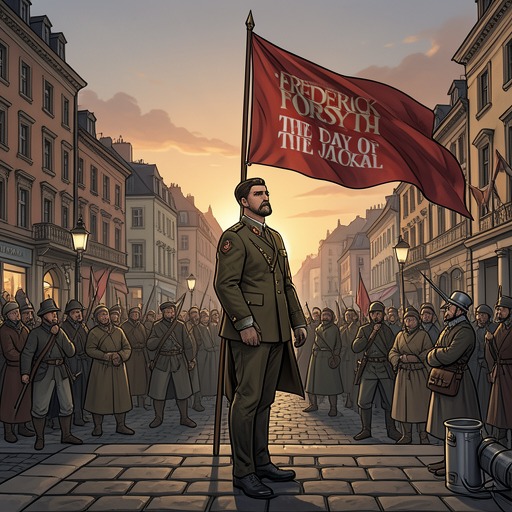
The Jackal's plot to assassinate Charles de Gaulle
The Day of the JackalThe Secret Army Organisation’s plot to assassinate Charles de Gaulle begins as an answer to failure: with its French networks infiltrated and its known gunmen exposed, the OAS turns to an outsider whose very absence from police files might let him cross the security barrier. Marc Rodin recruits an English professional assassin who chooses the name The Jackal, pays him to act independently, and accepts that the mission may be almost impossible to escape. The resulting contest is not only between assassin and target but between a secret plan designed to evade institutions and a police inquiry forced to mobilize those institutions before the plan can run its course.
Causes and Strategic Problem
By March 11, Marc Rodin was approaching the assassination of Charles de Gaulle as a practical problem rather than simply an act of militant resolve. The failed Petit-Clamart assassination attempt and the École Militaire plot had made the task harder: security now surrounded the President in concentric rings, and an assassin would need some unusual advantage to get through them. Rodin’s method was to list the obstacles, test possible plans, and discard each one that failed his final scrutiny. Security, not a shortage of people willing to kill, emerged as the difficulty that defeated every conventional approach.
That difficulty reflected a wider collapse inside the Secret Army Organisation. After the Petit-Clamart failure and the interrogation of prisoners, three networks in France had to be shut down. French police, acting on inside information, raided safe houses and uncovered weapons and supplies; two further plots were overwhelmed before the conspirators could progress beyond their second meeting. The recent kidnapping of Antoine Argoud also showed how far the SDECE Action Service would go to reach and interrogate OAS leaders. For Rodin, even the risk of provoking a serious quarrel with the German government did not make the threat less real.
The organization was short of money and losing support, members, and credibility. The execution of Jean-Marie Bastien-Thiry further damaged morale. Men willing to act were increasingly recognizable to the police and the public, while an operation requiring coordination among multiple groups was likely to be betrayed before its assassin came within reach of Charles de Gaulle. Rodin’s solution grew out of that narrowing field of options: a man unknown to French police, unaffiliated with the OAS or the National Resistance Council, and absent from the files by which the security services tracked its own enemies.
The Outsider and the Contract
Rodin had begun searching for a professional mercenary assassin after hearing of Jean-Marie Bastien-Thiry’s execution. He conducted the inquiries himself, keeping the idea from others and eventually bringing three manila dossiers to a meeting with René Montclair and André Casson. The folders listed candidates in order of preference, in case the first choice could not or would not take the job. The meeting marked a shift in Rodin’s standing: after Antoine Argoud’s kidnapping, he had moved from the background into leadership in his own right, and he now presented a plan built around the organization’s vulnerabilities rather than its rhetoric.
The candidate who came to meet them was an Englishman. He had already read what information was available about the OAS, and Rodin judged that his composure and professional experience made him the kind of outsider the plan required. Rodin did not begin by demanding a commitment. He asked whether the killing could be done. The Englishman answered that Charles de Gaulle could be killed, but stressed that the central problem was surviving the attempt. A fanatic might accept his own death and act without hesitation; a professional, he argued, would be more calculating, less prone to elementary mistakes, and unwilling to proceed until he had devised a way to complete the mission and escape.
The exchange established the price as well as the terms of the risk. The Englishman demanded half a million dollars in cash, half in advance and half on completion. He treated the work as a once-in-a-lifetime contract: the assassin would be unlikely to work again, and the payment had to provide for the rest of his life as well as protection against Gaullist reprisals. Rodin and his associates agreed to the amount, despite the size of the sum. Their agreement converted an abstract proposal into a commission, but it did not give them control over how the operation would be carried out.
The Englishman made that limit explicit. Only Rodin, Montclair, and Casson were to know that the OAS was considering an outsider, and no one beyond the three men was to learn his identity. All records of meetings, files, and dossiers were to be destroyed. If any of the three were captured, he reserved the right to cancel the contract. He also required them to stay somewhere safe and under heavy guard. The restrictions answered the same problem that had produced the scheme: every additional person or surviving record could become another route by which French intelligence discovered the plan.
The Jackal’s Independence
The assassin claimed the right to devise and execute the operation alone. He would disclose no details of his planning, would disappear from his known London address and telephone number, and would make no routine contact with the OAS. His movement would begin only when he was ready and the first $250,000 had been deposited in a Swiss bank, whichever came later. The agreement left him beyond Rodin’s direction: he would not be hurried or interfered with, and the organization would not know his whereabouts.
The OAS could offer information from its agents in France, some of them highly placed, but even that assistance was tightly limited. Rodin was to send a single telephone number, preferably in Paris, through which the assassin could request current information about the President’s security. The person answering would be told only that he was helping someone on a mission for the OAS, not that he was assisting an attempt on Charles de Gaulle’s life. Even that contact’s sources were to be restricted to people able to provide useful inside information, rather than material available in newspapers. The arrangement created a narrow channel for intelligence without giving the organization a view of the operation itself.
When Rodin asked what name the Englishman wished to use, he chose The Jackal, drawing on the conversation’s imagery of hunting. Rodin accepted the codename and asked him to begin general planning so that no time would be lost. The visitor left quietly; after spending the night at an airport hotel, he flew back to London the next morning. His departure made the division of labor tangible: the OAS had hired the assassin, but from then on the mission’s shape and timing would belong to him.
Exposure and the Manhunt
The plan’s secrecy did not prevent the French authorities from learning that a professional political assassin might be involved. Claude Lebel received an urgent directive from the Minister of the Interior and was given access to the resources of the officials and services around the conference table. He organized his office for sustained work, made his assistant and secretary the sole additional person inside the secret, and demanded dedicated telephone lines and priority access to other departments. The scale of that mobilization contrasted with The Jackal’s deliberate isolation: one side built a central command from public institutions, while the other preserved the advantage of a timetable known to its author alone.
Lebel began by asking police forces abroad to look for a political contract killer with successful assassinations behind him. He could provide little more than a poor description and no name, and he could not initially present the request as an ordinary formal inquiry. The decisive clue was the nature of the suspected profession itself. If the target was Charles de Gaulle, the search had to extend beyond familiar gangland killers to assassins whose records might sit in foreign police files, even if they had never operated in the country being asked to help.
As the inquiry progressed, routine records began to give the unknown man a usable identity. A card showed that Alexander James Quentin Duggan had entered France on the Brabant Express from Brussels on July 22. Another frontier report recorded a passenger with that name leaving Paris for Brussels on July 31. A hotel card, carrying a passport number that matched information from London, placed Duggan at a small hotel near the Place de la Madeleine from July 22 through July 30. Lebel chose to visit the hotel proprietor quietly rather than have the police raid it; the proprietor confirmed that the man had left by August 15. The sequence turned a pseudonym into a trail, but it did not reveal where The Jackal stood in his own preparations.
Lebel warned the senior officials that the assassin might already be in France, perhaps even in Paris. The police had been investigating for seventy-two hours, but they could not know how far The Jackal had progressed according to his private timetable. Their advantage was also their uncertainty: once he knew that the plot had been discovered in principle, he still might not know what the police had learned about his identity or location. The immediate aim was therefore to identify him under his new name and locate him without alerting him before an arrest could be made.
When a car was found near Ussel, Lebel ordered a broad local search rather than a conspicuous approach to a suspected hiding place. Commissaire Valentin was told to send as many capable officers as possible, center a square search on the car’s location, and question farms, roadside users, village shops, cafés, hotels, and woodcutters’ shelters. The searchers were to look for a tall, blond Englishman who spoke good French, had three suitcases and a handgrip, carried substantial cash, and might look as though he had slept rough. The press was to be kept away with a cover story, and if officers found him they were to surround the location and wait rather than approach him. The instructions show how the investigation translated a thin description into a field operation while trying to prevent publicity from destroying its chance of surprise.
Lebel connected the altered car to a possible warning. The assassin must have bought paint to transform it; if the drive from Gap to Ussel had begun with the car already changed, then the paint had probably been bought in Gap. That timing suggested that The Jackal had received information about the discovery of the Duggan identity and escaped before the police could close in. Lebel could not establish that a leak came from inside the conference, since information passed through switchboard staff and other levels of the bureaucracy. He did, however, conclude that the assassin had been warned both that the assassination plot was exposed and that Duggan had been unmasked—and had decided to continue regardless.
The delay that had puzzled Lebel then became evidence of a plan rather than evidence of hesitation. The Jackal had left Gap without immediately adopting another identity and traveling to Paris; he had spent a week in France instead. Lebel inferred that the assassin had selected a particular day for the killing and was waiting for it. That deduction shifted the police question from where The Jackal had been to when Charles de Gaulle would be exposed. By then the pursuit had become a race against a schedule the police could only infer from absences and traces.
At the edge of the ceremony’s security perimeter, an officer reported that the street had been closed since noon and that no one had passed through a gap except an old, visibly sick cripple who lived nearby. The man had shown an identity card and a War Invalid card, giving an address on Rue de Rennes. The report supplies a final, concrete measure of the plot’s central advantage: the security system had inspected the credentials it was presented with, yet ordinary permission to pass could become a route through the barrier. The wider scheme thus turns on the clash between files and what they cannot contain, between institutional scrutiny and a person whose assumed identity can make him appear to belong.
Significance
The plot is built around a paradox. The OAS chooses an outsider because its own members and channels are compromised, but the outsider’s usefulness depends on keeping the organization itself at a distance. Rodin’s political objective and The Jackal’s professional conditions briefly align, then separate: the OAS needs the President dead as a step toward its projected restoration of France, while the assassin insists on his own timetable, methods, and survival. The contract does not resolve the political conflict; it imports a specialist into it and makes secrecy the price of cooperation.
The police narrative answers this design with its own accumulating procedures. International calls, archive cards, hotel registration, vehicle evidence, and local questioning do not immediately deliver the assassin; each narrows what can be said and what must be tested next. Lebel’s work is collective even when his deductions focus the search. The suspense comes from the mismatch between the huge apparatus mobilized against The Jackal and the small number of facts it can securely place on his private schedule. The plot’s decisive question is therefore not only whether Charles de Gaulle can be reached, but whether a system built to recognize known threats can stop a man whose advantage is to remain unknown.